Medcan’s guide to injections for joint and pain management
Muscle and joint function impact how you move, feel and live each day. When your body operates with strong, coordinated muscles that support smooth, pain‑free joints, you’re able to stay active, maintain independence, and perform at your best. But when pain, stiffness or injury interrupt that balance, the effects can ripple into your daily routines, confidence and overall quality of life.
At Medcan, our Sports Medicine, Therapy and Rehabilitaiton services offer a comprehensive range of options to manage pain, support recovery, and maintain long‑term mobility. Whether you’re dealing with a sports injury, joint degeneration or age‑related wear and tear, our team aligns treatment to your goals to ensure you receive the right interventions.
As part of our evidence‑based approach, we offer injections that reduce pain, improve mobility and support healing. However, despite how common muscle, joint and arthritis related concerns are, we’ve found that many people are unsure about injection options. We’ve also seen how that injection of confusion can lead to delayed care or choices that don’t fully address the underlying issue.
This guide was designed to give you clarity. It breaks down the most common injections, who they’re for and what to expect, so you can make informed, confident decisions about your muscle and joint health.
Who might benefit from an injection?
Most of our clients at Medcan who benefit from injection‑based treatment fall into three categories: athletes (professional and recreational), active adults, and individuals experiencing age-related changes.
Recreational and professional athletes
At Medcan, we see a great deal of recreational and competitive athletes seeking accelerated return-to-play or integrated rehabilitation and conditioning so they can stay active. These individuals may also be managing overuse or sport‑related injuries.
An overuse injury is an injury that develops gradually over time when a muscle, joint, tendon or bone is repeatedly stressed without enough recovery for the body to repair itself between activities. Those who run, cycle, play sports or work out regularly often experience these types of overuse injuries or tendon irritation and joint wear that can disrupt life and bring pain.
Busy professionals with performance issues and injuries
Many active adults come to us for fast, expert care for musculoskeletal issues or to work on performance goals. These individuals are often recovering from muscle, tendon or joint issues that haven’t improved with basic treatments like rest, physical therapy or medication. They might also be dealing with sprains, strains, tendonitis, bursitis or muscle tears.
Busy office workers and executives can develop musculoskeletal issues from postural behaviours, prolonged sitting, screen use, stress and limited recovery time. Additionally, those who are in physically demanding jobs like healthcare or trades or anyone doing repetitive movements or heavy lifting can develop chronic muscle or joint pain.
If rest, physical therapies, exercise or over‑the‑counter medication hasn’t helped, therapeutic injections might be an option.
Individuals impacted by age-related change, such as joint degeneration or early signs of osteoarthritis
As the body ages, cartilage thins and joints can become stiffer. Many people in midlife and older experience knee, hip, shoulder or spine pain that can be helped by targeted injection therapy.
People with osteoarthritis or early signs of “wear and tear” are another group that may benefit from injections. Joint degeneration – especially in the knees – can cause ongoing pain, stiffness, or swelling where injections provide both relief and improved mobility. Injections allow many people to stay active while avoiding or postponing more invasive procedures.
These three groups represent most of the clients we treat who are seeking targeted pain relief, improved mobility, and accelerated healing through Medcan’s suite of injection therapies. And the goal for each group is the same: to get you back to health – where you're moving comfortably and staying active.
What do injections do?
An injection may be a great option when pain, inflammation or mobility problems aren’t improving at all or fast enough with first‑line treatments like exercise therapy, rest, oral medications or lifestyle changes. Here are four scenarios your physician might recommend an injection:
- Reduce pain and inflammation when it’s difficult for you to move
Inflammation can be so painful that a person avoids movement, which leads to stiffness, weakness and worsening symptoms. An injection lets them “break the cycle.” It can also allow them the ability to perform rehabilitation exercises that improve the situation. - Improve joint lubrication and cushioning
When cartilage thins in osteoarthritis, joints grind and stiffen. Lubrication like injections help smooth movement and can make walking, climbing stairs and exercising tolerable again. - Support healing
Certain injections support regeneration. They address the underlying tissue damage and not only reduce symptoms. - Manage chronic pain and avoid surgery
Not everyone is ready for (or needs) surgery. Injections can provide months of relief and keep joints functioning while patients work on strength, mobility and activity modifications.
How do physicians choose an injection?
Your physician will consider your individual situation, health history, and do a cost-benefit analysis to decide if, and what, injection is right for you. Here are common questions they’ll consider:
- What’s causing the pain? Your physician will check whether the issue is inflammation, arthritis or a tendon or ligament problem.
- How quickly do you need relief? Some injections work fast but don’t last as long, while others take longer to kick in but offer longer‑term benefits.
- What are your goals? Whether you want quick relief to stay active or avoid surgery influences the choice.
- What have you already tried? Past treatments, such as exercise therapy, medications or previous injections, will be taken into account to help guide the next steps.
- What does imaging show? X‑rays or ultrasounds may be used to confirm what’s happening inside the joint or tissue.
- What’s your health background? Your physician will evaluate whether you have additional conditions, like diabetes, to take into consideration. They will also account for medication use or past reactions that can affect which option is safest.
- How many injections may be needed? Some treatments are one‑and‑done while others require repeat visits.
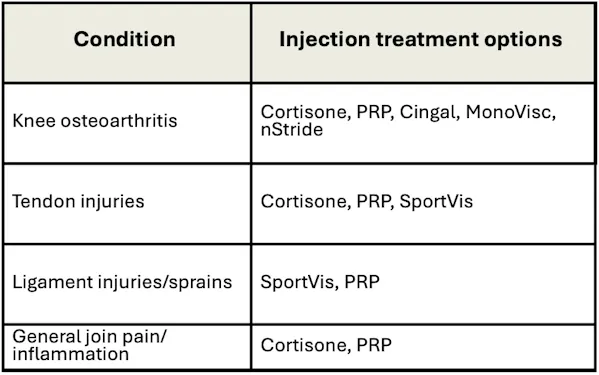
Type of injections
Based on these questions, a physician may suggest injections. At Medcan, there are six types we commonly recommend:
- Cortisone (Corticosteroid)
- PRP (Platelet-Rich Plasma)
- Cingal
- SportVis
- MonoVisc
- nStride
Understanding injections – a deeper review of the six types
Cortisone (Corticosteroid)
What is a cortisone injection?
Cortisone is a powerful anti‑inflammatory medication. It is a part of a class of medications known as corticosteroids that mimic hormones produced by the adrenal glands.
How do they work?
Cortisone is injected directly into areas that cause pain, such as the knee, shoulder, hip, spine or small joints. It is designed to quickly reduce pain and inflammation inside a joint or in the surrounding soft tissues.
When part of your body gets irritated or injured, your body signals cells and chemicals to move to the area, and that process is what causes inflammation – redness, swelling, heat, pain – in your body. Inflammation is part of the body’s normal immune response and is a sign it’s trying to heal. When tissue is injured or irritated, the body increases blood flow to the area and sends immune cells to protect against infection, remove damaged tissue and repair. However, excessive Inflammation that is too strong or lasts longer than expected is not always beneficial. In these cases, reducing inflammation can help facilitate healing.
If a person has too much inflammation – where everything hurts and they can’t move – the body can’t move into a tissue‑regrowth stage. In these situations, lowering inflammation with cortisone can unlock the next phase of healing because it makes movement and rehabilitation possible.
Who are they for?
Cortisone injections are typically recommended for:
- Osteoarthritis flare‑ups
- Bursitis
- Tendonitis (around- but not into -tendons)
- Joint inflammation
- Acute pain episodes that limit movement
These injections are especially helpful when inflammation is severe enough to interfere with daily activities or prevent progress in rehabilitation.
What can you expect before, during, and after a cortisone injection?
Before the injection, your physician will review your medical history and confirm that a cortisone injection is appropriate for your condition. You may be asked about current medications, especially blood thinners or diabetes medications, recent infections, or upcoming surgeries. In some cases, medications that increase bleeding risk may need to be paused, but only under physician guidance.
The injection itself is usually brief, lasting only a few minutes. The area is cleaned thoroughly to reduce infection risk, and a small needle is used to deliver the medication into or around the painful joint or tissue. Some injections are also performed using ultrasound guidance, which helps the physician place the medication precisely in the intended location. This can improve accuracy and effectiveness, particularly around deeper joints or soft‑tissue structures.
You may feel a brief pinch or pressure or mild discomfort as the medication is injected. However, most people tolerate the procedure well.
After the injection you may experience temporary soreness or stiffness at the injection site, a sensation of fullness or pressure in the joint. Some people experience a post‑injection flare where pain briefly worsens within the first 24–48 hours. However, this usually settles with rest and ice.
What are the expected results?
Cortisone injections are known for fast relief, but timing can vary. Some people notice improvement within 24–72 hours. Others may take up to one week to feel the full benefits. Relief can last weeks to a few months, depending on the condition being treated and the severity of inflammation.
Light activity is usually encouraged after 24 hours. Strenuous exercise or heavy loads to the injected area should be avoided for 24–48 hours. Physiotherapy typically resumes once pain settles, often within a few days and during your pain relief window, it is often a good idea to focus on rehabilitation exercises that restore strength and movement.
Risks, side effects, and safety considerations
Cortisone injections are generally safe when used appropriately and sparingly and delivered by trained clinicians. Common, temporary side effects may include mild pain or swelling at the injection site, short‑term stiffness, or temporary facial flushing. These typically resolve within a few days.
Corticosteroids can also raise blood glucose levels. People with diabetes or prediabetes, may see temporary spike in blood sugar lasting 1–3 days, though in some cases it may persist up to 5–7 days, depending on the dose, type of steroid, and injection location. People without diabetes may also see a mild rise, but it is usually clinically insignificant.
Repeated injections in the same area should also be carefully monitored because they can weaken tendons and cartilage, especially in weight‑bearing joints. It is not recommended to inject cortisone directly into a tendon because it may cause weakening or rupture.
Platelet‑Rich Plasma (PRP)
What is a Platelet‑Rich Plasma (PRP) injection?
Platelet‑Rich Plasma (PRP) is a regenerative treatment that uses a concentrated portion of your own blood, and specifically your platelets – which release chemical signals that help trigger blood clotting and tissue repair – that support healing in injured muscles, tendons, ligaments or joints.
Platelets play an important role in the body’s natural repair process. They contain growth factors and signaling proteins that help regulate inflammation, stimulate tissue repair and support recovery after injury.
How does PRP work?
When tissue is injured or under chronic stress, the body attempts to heal itself through a complex biological process involving inflammation, cell signaling and tissue repair. In some cases – particularly with chronic or overuse injuries – this process can stall or become inefficient. This is where PRP may be an effective treatment.
PRP works by concentrating the body’s natural healing components and delivering them directly to the area of injury. To create PRP, a small sample of your blood is drawn. The blood is placed in a centrifuge, which spins it to separate and concentrate the platelets. The platelet‑rich portion is then injected into the injured tissue.
Rather than suppressing inflammation, PRP aims to optimize and direct the healing response, supporting tissue regeneration over time. Since PRP comes from your own blood, it is considered minimally invasive and has a low risk of allergic or systemic reaction.
Who is PRP for?
PRP injections are typically recommended for individuals with chronic or slow‑to‑heal musculoskeletal injuries, particularly when symptoms have not improved with rest, physiotherapy, or activity modification. PRP is commonly used for:
- Tennis elbow and golfer’s elbow
- Rotator cuff injuries
- Achilles tendinopathy
- Patellar and gluteal tendinopathy
- Chronic tendon or ligament injuries
- Mild to moderate joint osteoarthritis (in selected cases)
PRP is often chosen when the goal is healing and tissue repair, rather than short‑term pain suppression.
What can you expect before, during, and after a PRP injection?
Before the injection, your physician will review your medical history. You may be asked about blood‑thinning medications, anti‑inflammatory medications (which may need to be paused before treatment), recent illness or infection.
During the injection, the procedure involves two steps: a blood draw followed by the injection. The injection is often performed using ultrasound guidance, which helps ensure accurate placement into the injured tissue.
You may feel a brief needle pinch or pressure or discomfort during the injection. Since PRP is often injected directly into injured tissue discomfort during the injection can be more noticeable than with cortisone, but it is generally brief and well tolerated.
After the injection, soreness is common and expected. This may include localized pain or stiffness feeling like a “flare‑up” of symptoms. This reaction usually reflects the body’s healing response and typically settles over several days.
What are the expected results?
PRP does not provide immediate pain relief. Instead, improvement tends to occur gradually as healing progresses. Symptoms may also worsen slightly for the first few days. However, early improvement is often noticed within 2–4 weeks. Continued improvement may occur over 6–12 weeks or longer.
Activity is usually modified initially. You’ll likely be asked to rest from heavy or high‑impact activity for several days. PRP is often combined with a structured rehabilitation program to optimize results.
Some conditions may require more than one PRP injection, depending on severity and response.
Risks, side effects, and safety considerations
PRP injections are generally considered very safe because they use your own blood. Common, temporary effects are post‑injection pain or stiffness or mild swelling or soreness at the injection site. These effects usually resolve within days to a week.
PRP does not increase infection risk beyond any injection when performed under sterile conditions. There is no risk of allergic reaction to the injected material. Unlike cortisone, PRP does not weaken tendons or cartilage. However, PRP may not be appropriate for individuals with certain blood disorders, active infections, or specific medical conditions, which your physician will review during assessment.
Cingal
What is a Cingal injection?
Cingal is a single‑injection treatment for knee osteoarthritis that combines two therapies in one injection:
- Hyaluronic acid (HA) - a natural lubricant and shock absorber found in healthy joint fluid
- Triamcinolone hexacetonide - a corticosteroid that rapidly reduces inflammation
Hyaluronic acid is a naturally occurring substance found in healthy joint fluids. Hyaluronic acid helps lubricate and cushion joints, allowing them to move smoothly and absorb shock during everyday activity.
By combining these two components, Cingal is designed to provide both fast pain relief and longer‑lasting joint support.
How does Cingal work?
Osteoarthritis develops when joint cartilage thins and joint fluid loses its cushioning properties. This leads to increased friction, inflammation, pain and stiffness.
Cingal works through a dual‑action mechanism where the corticosteroid component quickly reduces inflammation inside the knee joint to help relieve pain within days. Meanwhile, the hyaluronic acid component helps restore lubrication and shock absorption to improve joint movement and comfort over time. Together, these effects help calm inflammation while also improving the mechanical environment of the knee joint.
Who is Cingal for?
Cingal injections are typically recommended for individuals with mild to moderate knee osteoarthritis who want both rapid symptom relief and sustained improvement.
Cingal is commonly considered for people who have ongoing knee pain, stiffness or swelling due to osteoarthritis and have not achieved adequate relief with exercise, physiotherapy or oral medications. It is also commonly offered to those who prefer a single‑visit injection rather than a series of treatments.
Since Cingal contains a steroid, it is primarily used for joint‑based inflammation, not tendon or ligament injuries.
What can you expect before, during, and after a Cingal injection?
Before the injection, your physician will assess your symptoms, review imaging if available (such as X‑rays) and confirm that Cingal is appropriate for your knee osteoarthritis. You may be asked about diabetes or blood sugar control, blood‑thinning medications and recent infections. Most people can eat and drink normally before the procedure.
The injection is typically performed in a clinic setting and usually takes only a few minutes. The knee is cleaned thoroughly, and a small needle is used to inject the medication directly into the joint. Some injections are performed using ultrasound guidance to ensure accurate placement into the joint space.
During the procedure you may feel a brief pinch or pressure or fullness in the knee. However, most people tolerate the procedure well.
After a Cingal injection, you may experience mild knee soreness, swelling, or a feeling of fullness or pressure in the joint. Some people experience short‑term discomfort in the first 24–48 hours, which usually resolves with rest and ice.
What are the expected results?
Cingal is designed to provide both immediate and longer‑term benefits. Pain relief from the steroid component may begin within a few days. Then, improvement continues as the hyaluronic acid component takes effect. Full benefits typically build over 1–5 weeks. Relief can last up to six months or longer, depending on individual response and disease severity.
After an injection, light activity is usually encouraged within 24 hours, and high‑impact exercise is often limited briefly. Physical therapy and strengthening may resume shortly thereafter.
Risks, side effects, and safety considerations
Cingal is generally well tolerated when used appropriately, but side effects may occur. Common, temporary side effects include mild knee pain or swelling and injection‑site discomfort, but these impacts usually resolve within a few days.
Since Cingal contains a corticosteroid, injections are typically limited in frequency (often no more than 3–4 per year in the same knee). People with diabetes may experience a temporary rise in blood sugar for 1–3 days, and repeated steroid exposure over time may affect cartilage health.
MonoVisc
What is a MonoVisc injection?
MonoVisc is a joint lubricant, medically known as a viscosupplement injection, made of hyaluronic acid. MonoVisc is most used to treat knee osteoarthritis and is designed to provide longer‑lasting symptom relief through a single injection, rather than a series of injections.
How does MonoVisc work?
In healthy joints, hyaluronic acid helps maintain smooth, pain‑free movement by reducing friction between joint surfaces. In osteoarthritis, the concentration and quality of hyaluronic acid in joint fluid declines, leading to stiffness, pain, and reduced mobility.
MonoVisc works by restoring lubrication and cushioning within the joint. Once injected into the knee, it improves joint lubrication, helps absorb shock during movement, reduces friction and mechanical stress.
Rather than targeting inflammation directly, MonoVisc improves the mechanical environment of the joint, making movement more comfortable over time.
Who is MonoVisc for?
MonoVisc injections are typically recommended for people with mild to moderate knee or hip osteoarthritis who continue to experience pain or stiffness despite conservative treatments such as exercise therapy, physiotherapy, weight management or oral medications.
MonoVisc may be appropriate for individuals who have knee pain related to cartilage wear or experience stiffness or difficulty with walking, stairs, or activity. It is often recommended to those who prefer a non‑surgical, non‑steroid treatment option and are looking for longer‑lasting relief without multiple injection visits.
MonoVisc is specifically indicated for joint‑based conditions and is not used for tendon or ligament injuries.
What can you expect before, during, and after a MonoVisc injection?
Before the injection, your physician will review your symptoms, medical history, and imaging (such as X‑rays, if available) to confirm that MonoVisc is an appropriate option. You may be asked about previous knee injections, blood‑thinning medications, recent infections or upcoming procedures.
The procedure is typically completed in just a few minutes. The knee is cleaned thoroughly, and a small needle is used to inject MonoVisc directly into the joint space. Ultrasound guidance may be used to ensure accurate placement, particularly in cases where joint space access is more challenging.
You may feel a brief pinch from the needle. Pressure or fullness in the knee during injection. Most people tolerate the procedure well. Following the injection, it’s common to experience mild soreness or swelling at the knee, a temporary feeling of stiffness or fullness. These effects are usually mild and resolve within a few days with rest and gentle activity.
What are the expected results?
Unlike cortisone, MonoVisc does not provide immediate pain relief. Instead, symptom improvement develops gradually as joint lubrication improves. Some people notice improvement within 2–4 weeks. Maximum benefits often occur by 4–6 weeks. Relief can last several months, and in some individuals up to six months or longer.
After injection, light activity is generally encouraged within 24 hours. High‑impact or strenuous activity may be limited briefly. Physiotherapy or strengthening exercises often resume as comfort improves.
Risks, side effects, and safety considerations
MonoVisc is generally well tolerated and has a favorable safety profile. Common, temporary side effects mild knee pain, swelling or stiffness and injection‑site discomfort. However, these typically resolve within a few days.
MonoVisc does not contain steroids, so it does not affect blood sugar levels. It also does not weaken tendons or cartilage. Infection risk is very low when performed under sterile conditions. MonoVisc may not be appropriate for people with active joint infections or known allergies to hyaluronic acid products.
It’s a convenient option for individuals seeking improved comfort and mobility while delaying or avoiding more invasive treatments.
SportVis
What is a SportVis injection?
SportVis is a hyaluronic acid–based injectable treatment designed to support recovery from soft‑tissue injuries and certain joint conditions, particularly in active individuals. Unlike traditional viscosupplement injections that are primarily used for osteoarthritis, SportVis is formulated for sports‑related and activity‑based injuries, where pain, stiffness or limited motion may interfere with movement and performance.
How does SportVis work?
Soft‑tissue injuries such as ligament sprains, tendon irritation, or joint trauma can create increased friction and mechanical stress within and around the affected area. This stress often contributes to pain, stiffness, and difficulty moving normally.
SportVis works by enhancing lubrication and mechanical protection in the injured area. Once injected, it helps reduce friction between tissues during movement, improve joint or soft‑tissue gliding and decrease mechanical irritation that can slow recovery.
Rather than suppressing inflammation, SportVis focuses on improving the physical environment of the tissue. This allows healing to occur more comfortably during rehabilitation and return to activity.
Who is SportVis for?
SportVis injections are typically recommended for active individuals dealing with musculoskeletal injuries that have not fully responded to rest, physiotherapy or activity modification.
SportVis is commonly used for:
- Ligament sprains
- Tendon irritation or overuse injuries
- Ankle or knee joint injuries
- Soft‑tissue pain related to sports or repetitive activity
It may be considered when the goal is to support recovery and improve movement without relying on steroid‑based injections.
What can you expect before, during, and after a SportVis injection?
Before the injection, your physician will assess your injury, review your medical history, and confirm that SportVis is appropriate for your condition. You may be asked about current medications, including blood thinners, recent infections or injuries, your activity level and rehabilitation goals.
The area will be cleaned thoroughly, and a small needle is used to deliver the injection into or around the injured tissue. Ultrasound guidance may be used to ensure precise placement, especially when injecting around ligaments, tendons or deeper joint spaces.
You may feel a brief needle pinch or pressure or mild discomfort during injection. Most people tolerate the procedure well. After SportVis injection, it is common to experience mild soreness, stiffness, or swelling at the injection site and temporary discomfort with movement. These symptoms usually resolve within a few days and can be managed with rest and ice.
What are the expected results?
SportVis does not provide instant pain relief, but improvements often occur relatively quickly as tissue gliding and movement become more comfortable. Some people notice improvement within a couple of weeks. Additionally, symptom relief may continue to build with ongoing rehabilitation
The treatment is often delivered as a short course of injections, commonly two injections spaced about one week apart. After injection, light activity is usually encouraged within 24 hours. High‑impact or sport‑specific activity may be temporarily limited. Physical therapy and rehabilitation continue as guided by your care team.
Risks, side effects, and safety considerations
SportVis is generally well tolerated and has a favorable safety profile. Common, temporary side effects are mild pain, swelling, or stiffness at the injection site or brief discomfort during movement. These effects typically resolve within a few days.
SportVis‑specific considerations. SportVis does not contain steroids, so it does not weaken tendons or affect blood sugar. It does not suppress the body’s natural healing response. Infection risk is very low when injections are performed using sterile technique
SportVis may not be appropriate in the presence of active infection or certain medical conditions, which your physician will review during assessment.
By improving movement comfort and protecting healing tissues, SportVis can play a valuable role in rehabilitation and return‑to‑activity strategies without relying on steroid‑based inflammation control.
nStride
What is an nStride injection?
nStride is an injectable treatment that uses a patient’s own blood to create an Autologous Protein Solution (APS). It is designed specifically to help manage knee osteoarthritis by targeting the inflammatory processes that drive pain, stiffness and swelling within the joint.
Unlike treatments that focus mainly on pain relief or joint lubrication, nStride aims to modify the inflammatory environment inside the knee, supporting longer‑term symptom improvement.
How does nStride work?
nStride works by concentrating anti‑inflammatory proteins and growth factors from your own blood, injecting this solution directly into the knee joint and reducing inflammatory signals while supporting a healthier joint environment.
To create nStride, a small blood sample is drawn and processed in a specialized system that concentrates anti‑inflammatory components, and the resulting solution is injected into the knee. Since nStride uses your own blood, it is considered minimally invasive and avoids exposure to synthetic medications.
Who is nStride for?
nStride injections are typically recommended for individuals with mild to moderate knee osteoarthritis who continue to experience pain, stiffness or swelling despite conservative treatments. nStride may be appropriate for people who:
- Have chronic knee pain driven by inflammation
- Have not achieved sufficient relief with exercise, physiotherapy, or oral medications
- Prefer a non‑steroid, single‑injection option
- Are looking for longer‑lasting symptom relief
- Want to stay active while delaying or avoiding surgery
nStride is currently used for knee osteoarthritis only and is not indicated for tendon, ligament or soft‑tissue injuries. Osteoarthritis is not only a “wear‑and‑tear” condition. It it is also driven by chronic, low‑grade inflammation within the joint. Certain inflammatory proteins (cytokines) contribute to pain, cartilage breakdown and worsening stiffness over time.
What can you expect before, during, and after an nStride injection?
Before the injection, your physician will review your symptoms, medical history, and imaging (if available) to ensure nStride is an appropriate option. You may be asked about blood‑thinning medications, autoimmune conditions or blood disorders, or recent infections. Anti‑inflammatory medications may be limited around the time of treatment to avoid interfering with the intended biological response.
The procedure involves a blood draw followed by an injection into the knee joint. The injection is typically performed using ultrasound guidance to ensure accurate placement within the joint space.
You may feel a brief needle pinch and pressure or fullness in the knee. The procedure is generally well tolerated. Following treatment, it’s common to experience mild knee soreness or stiffness, temporary swelling or discomfort. These symptoms usually resolve within a few days. A short period of activity modification is often recommended.
What are the expected results?
nStride does not provide immediate pain relief. Instead, improvements tend to develop gradually over time as inflammation within the joint decreases. Some people begin to notice improvement within 2–4 weeks. Continued improvement may occur over several months
Many individuals report symptom relief lasting six months to a year or longer following a single injection.
After injection of light activity is typically encouraged within a few days. High‑impact activity may be limited initially. Physiotherapy and strengthening programs are often continued to support joint health
Risks, side effects, and safety considerations
nStride has a favourable safety profile when performed by trained clinicians. Common, temporary effects are mild pain, stiffness, or swelling at the injection site and temporary flare of knee discomfort. But these typically resolve within days.
nStride does not contain corticosteroids, so it does not affect blood sugar levels. Since it is derived from your own blood, there is a very low risk of allergic reaction and infection risk is low when sterile technique is used. However, nStride may not be appropriate for individuals with certain blood disorders, active infections, or specific medical conditions, which your physician will assess prior to treatment.
Who should not use injections (and why):
Your physician and care team will review your health history to determine whether an injection is the right option for you. While many people are good candidates, certain individuals may need to avoid injections in the following situations:
- Active infection (local or systemic): injections shouldn’t be given when an infection is present because they can worsen or spread it.
- Blood disorders or abnormal platelet levels: PRP‑based treatments require healthy platelets, so clotting disorders or low platelet counts make the procedure unsafe or ineffective.
- Active cancer, especially blood cancers: PRP is avoided in active cancer because its growth factors could theoretically stimulate tumour activity.
- Severe liver disease: liver disease can impair clotting and platelet quality, making PRP therapies unsafe.
- Pregnancy or breastfeeding: PRP is postponed during pregnancy and breastfeeding due to lack of safety data.
- Uncontrolled autoimmune disease: some autoimmune conditions may react unpredictably to PRP, so treatment depends on physician assessment.
- Allergy to injection ingredients: anyone with a known allergy to the injection substances (like cortisone or HA components) should avoid treatment.
- Fracture at or near the site: injections aren’t appropriate around a fracture because they can interfere with healing or worsen the injury.
- Structural tendon risk where cortisone may cause harm: cortisone shouldn’t be injected directly into tendons because it can weaken them over time.
- Excessive anticoagulant therapy: blood thinners can increase bleeding risk and reduce the effectiveness of PRP‑based treatments.
How injections fit into a larger treatment plan
Injections can play an important role in managing muscle and joint pain and are most effective when used as part of a broader, coordinated treatment plan, not as a standalone solution.
At Medcan, injections are considered tools that support recovery, improve movement and create the conditions needed for long‑term improvement, rather than quick fixes on their own. Injections should support rehabilitation, not replace it.
Injections reduce pain and inflammation to improve joint lubrication or tissue comfort, creating a window where movement feels more manageable. That window is critical because movement and rehabilitation are what drive lasting improvement. Without follow‑up rehabilitation, the underlying causes of pain often remain unchanged.
Strength, mobility, and load management matter because pain rarely exists in isolation. It’s often influenced by muscle weakness or imbalance, limited joint mobility, poor movement mechanics, sudden changes or overload in activity.
Injections can reduce symptoms but they don’t rebuild strength, restore mobility or retrain movement patterns. That’s why long‑term success depends on addressing these foundations.
Rehabilitation is critical for:
- Strengthening the muscles that support joints
- Restoring joint range of motion
- Improving coordination and control
- Managing training or activity load to avoid flare‑ups
When paired with injections, these efforts are often more effective because people can move with less pain and greater confidence. For example, a knee osteoarthritis injection may be paired with a strengthening program for hips, quads, and core. A PRP injection for a tendon injury is followed by carefully graduated loading, not resting alone. SportVis may be used alongside rehabilitation to support return‑to‑sport movement without over‑reliance on medication.
At Medcan, injection therapy is typically integrated with:
- Supervised rehabilitation and exercise therapy delivered by an experienced physiotherapist, chiropractor and/or exercise specialist
- Activity or load modification, especially for athletes or physically demanding jobs
- Lifestyle factors, such as sleep, nutrition, weight management, and stress – all of which influence inflammation and recovery
This coordinated approach helps ensure that symptom relief leads to meaningful, functional improvement, not just temporary comfort.
The takeaway
Injections are valuable tools that support movement, rehabilitation and recovery. Some are primarily used to reduce inflammation. Others focus on long‑term joint health. And some offer a combination of both short‑term relief and longer‑term benefit. Certain injections use healing components from your own blood to support tissue repair, while others work by mimicking or supplementing substances naturally found in the body.
The choice of injections depends on your condition, goals, lifestyle, medical history and how often you’re able to attend clinic visits. Care should be tailored to individual needs rather than a one‑size‑fits‑all approach.
While these therapies can be highly effective, they are not quick fixes. Their greatest value comes when they’re combined with therapy, strength training and smart activity management. Used this way, injections can play a meaningful role in reducing pain, restoring function and helping you move more comfortably and stay active over the long term.