Multi-cancer screening at Medcan: six months of the Galleri® test leads to early interventions
Thousands of tests, treatment plans triggered and cancers caught proactively
Last October, Medcan became the first official Canadian provider of the Galleri® multi-cancer early detection (MCED) test by GRAIL, which sets the standard for multi-cancer early detection.
Through a single blood draw, this innovative, clinically validated test screens for 50+ cancer types, like pancreatic and ovarian, before they become symptomatic. And in the last six months, we’ve experienced its impact. The test has helped us identify multiple cancers that are typically detected only at later stages, while also providing a reassuring No Cancer Signal Detected result to thousands of Medcan clients.
Building on this experience, this article brings together what our team has learned through real‑world use, clinical insight, and client relationships. We also walk through how the Galleri test works, what the results mean and what the process looks like - from blood draw to next steps - to help you make informed decisions about proactive multi-cancer screening.
Why we brought the Galleri test to Canada
In a survey we conducted last year, we learned that cancer was the number one health area where our clients wanted proactive support. This is not a surprise given about 2 in 5 Canadians will develop cancer in their lifetime, and current statistics reveal that 1 in 4 die from the disease.
The risk of cancer also affects Canadians over 50 disproportionately, and we know that many of our clients are at a higher risk due to age. Nearly 90% of new cancer cases and 96% of cancer deaths occur among those aged 50 and over.
The Galleri test is an innovative, evidence-based approach known as multi-cancer early detection (MCED). MCED tests are a new category of blood‑based screening tests designed to look for biological signals of multiple cancer types, often before symptoms appear.
MCED tests are useful tools that provide additional screening insight beyond what is currently addressed by existing programs. In Canada, population‑level early screening is offered for four cancers - breast, cervical, colorectal, and lung - based on strict criteria tied to prevalence and evidence. Prostate cancer also has proactive screening guidelines, though there is no national consensus on population‑wide screening.
At Medcan, we include sex and age-specific screening, including prostate screening, in our Annual Health Assessment as part of a preventative approach. But as Medcan physician Dr. Steven Poirier, who has been involved with Medcan’s partnership with GRAIL since the beginning, points out, "Outside of the current screening options for those five cancers, we have had no other way to screen for most other cancer types.”
"Outside of the current screening options for those five cancers, we have had no other way to screen for most other cancer types.”- Dr. Steven Poirier, Medcan physician
At Medcan, we decided to offer the Galleri test as an option because the significant clinical evidence of this test shows us the value it can have in closing existing screening gaps.
Inside our early cancer detection experience: the test process, accuracy and client insights
What are the clinical results of the Galleri test?
The Galleri test by GRAIL is supported by comprehensive real-world experience and is currently the most extensively studied MCED test on the market.
It has been rigorously researched with demonstrated performance in an ongoing clinical program backed by more than 380,000 participants. Large-scale clinical trials include the CCGA (over 15,000 participants), PATHFINDER (~6,600 participants), and the largest interventional study of an MCED test in the United States to date, PATHFINDER 2 with 35,878 participants. Also underway is the NHS-Galleri trial in the UK with over 140,000 participants.*
To date, studies have shown that the Galleri test increases the number of cancers detected seven‑fold when added to standard screening for breast, cervical, colorectal, and lung cancers. They have also demonstrated that the test has detected a shared signal for more than 50 types of cancer and was able to accurately predict (in over 90% of cases) where in the body the cancer signal originated. This added insight helps direct follow‑up diagnostic testing and streamline what can otherwise be a complex process.
Studies also show that it has been able to correctly find cancer in about 76.3 of people who have one of a group of 12 deadly types of cancer. The test’s sensitivity is particularly high for detecting liver / bile duct (93.5%), pancreatic (83.7%), and ovarian (83.1%) cancers. These conditions are notoriously difficult to detect in their early stages, largely because they cause few or non‑specific symptoms and lack effective population‑wide screening tests. For more information on research and test accuracy, visit this page.
At Medcan, our experience aligns with the study results. “We’ve identified cancers like pancreatic cancer that we caught at stage 2 – along with other cancers including ovarian and colon,” said Dr. Poirier.
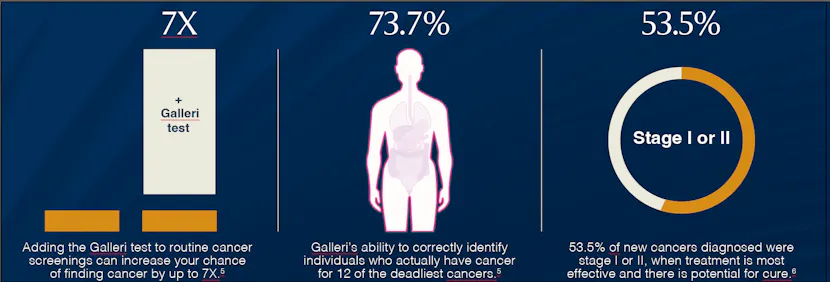
Nabavizadeh N, et al. Safety and performance of a multi-cancer early detection (MCED) test in an intended-use population: initial results from the registrational PATHFINDER 2 study [presentation]. European Society for Medical Oncology (ESMO) Congress; 2025 Oct 17-21; Berlin.
How does the test work?
The Galleri test process is straightforward, requiring only a single blood draw which is then sent to the GRAIL laboratory for analysis. Some of our clients complete the test on its own while many add it to their Annual Health Assessment, as they can complete all blood draws during the same appointment. When combined with the assessment, which includes recommended screenings like mammogram, this provides one of the most comprehensive approaches to proactive cancer screening in Canada.
While many clients complete the blood draw at a Medcan location, we now also offer the option to complete the draw through an in-home visit or through a local blood collection centre across Ontario.
The test works through innovative laboratory technology that can detect a unique cancer signal in the blood. As a natural occurrence, the cells in our bodies regularly grow and die. When they die, they release DNA fragments into the bloodstream. The DNA released by cancer cells is different than regular cells, creating a unique or signal that the test can pick up – hence why it is called a ‘cancer signal detected’ result. When a cancer signal is detected, the Galleri test also predicts the tissue in which the cancer signal may have originated. If no signal is identified during laboratory analysis, then the report will show a ‘no cancer signal detected’ result.
As part of the process, Medcan supports clients at every step of the way. We offer an optional pre-test consultation for those who wish to learn more about the test and discuss whether it is right for them. And if a cancer signal is detected, we walk the client through their results and provide comprehensive guidance and support to navigate next steps.
We have found that clients choose to complete the Galleri test for many reasons, ranging from concerns based on family history to a desire to be as proactive as possible when it comes to cancer. Since primary prevention options (e.g. vaccine) are limited for the majority of cancers, they recognize that early detection is crucial.
One client opted to complete the test on her daughter’s birthday because, as she told us, “I want to be there for my kids for many years to come.”
What results have Medcan clients received?
To date, the vast majority of our clients have received a ‘no cancer signal detected’ result, which is consistent with the GRAIL clinical trial data. While there is no follow-up required with this result, they are advised to continue with all recommended screenings per population screening guidelines and under the guidance of their healthcare provider. It is also recommended that the Galleri test is completed annually as it is a point in time test, and cancer can develop at any time.
While much rarer, some clients who have completed the test at Medcan have received a cancer signal detected result. Identified sites of origin have included pancreas, ovaries, thyroid, colon, and more. When these cases occur, we prepare an action plan for the client, coordinating care with their family physician and our referral partners as appropriate. A cancer signal detected result is not a cancer diagnosis, so additional testing is required to confirm if cancer is in fact present.
With any type of screening test, there is a possibility of false positive and false negative results. False positive results occur when a screening test indicates a Cancer Signal Detected result, but no cancer is present after diagnostic testing. One of the strengths of the Galleri test is that it has a low false positive rate of just 0.4%. This is important to us, as it means that we are not worrying a high number of clients unnecessarily. It also means that we take cancer signal detected results very seriously. When a cancer signal detected result is identified, we arrange follow-up diagnostic testing as quickly as possible, as this is an essential next step in confirming the result.
From our experience so far, the Galleri test has correctly identified cancer and the cancer site of origin in almost all cases where a cancer signal was detected. However, a cancer diagnosis requires additional imaging and testing, and for some cases we are continuing to work with clients who are still in the process of confirming a diagnosis.
What happens when a client receives a cancer signal detected result?
When a person completes the Galleri test and receives a cancer signal detected result, they will speak directly with a Medcan physician who delivers their results and guides them through a plan for next steps. The next steps generally are:
1. Preliminary confirmation
A preliminary confirmation typically includes an exam and / or imaging test(s) to verify a suspicion of cancer. This is when a physician does a deeper analysis and may find a suspicious nodule on a scan (like an MRI, ultrasound, x-ray, or CT) or a lesion found during a colonoscopy.
A preliminary confirmation does not mean a person has cancer. However, it does mean there’s enough evidence that they should see a specialist for additional testing.
2. Final confirmation
This is when there is proof that cancer is present. The evidence may come from a pathology test like a biopsy where cells under a microscope are reviewed and analyzed. In certain cases, an oncologist may determine that the imaging results are sufficient to support a diagnosis and begin treatment.
This is a similar process that doctors follow if there is a suspicion of cancer, whether due to an individual’s symptoms or incidental findings during a medical screening.
How long does it take to get a diagnosis after a cancer signal detected result?
In our experience, clients have been able to move through the diagnostic testing phases quite quickly. Follow-up testing may take anywhere from just a few days to several weeks, depending on medical triaging processes, the type of cancer suspected, and the type of tests ordered. Some clients may also pursue additional testing outside of the provincial system, including travel to other jurisdictions. However, it is important to note that every diagnostic testing journey is unique and the time to diagnosis can be longer or shorter depending on the specific case.
Since the Galleri test provides the predicted cancer site of origin, this can significantly decrease follow-up testing timelines, as it helps doctors know exactly which parts of the body to examine. As Dr. Poirier notes, “Being given a signal as to where to look for cancer is game-changing for a physician. Rather than looking for a needle in a haystack, we are told exactly where to look, and from my experience, the test has been right every time.’
Medcan’s Justin Lorentz, a certified genetic counsellor with a focus on oncology, works closely with the Galleri test and collaborates with clinicians both within and outside of Medcan. He notes that the site of origin is a highly useful clinical tool to help make the diagnosis process more efficient for everyone involved. “A predicted cancer site of origin provides clear direction for where to look, and if there are no suspicious lesions on imaging, we know to start considering the possibility of a false positive result.”
“A predicted cancer site of origin provides clear direction for where to look."- Justin Lorentz, Medcan certified genetic counsellor
What is it like to test, and receive a positive or negative result?
Our experience has demonstrated that most clients who complete the test express relief, no matter the result. Many clients who receive a no cancer signal detected result describe a sense of reassurance, saying: “I’m glad I did this,” or “This gives me real peace of mind.”
This relief is heartening, but we also caution clients that a no cancer signal detected result is not a guarantee that cancer is not present. We emphasize to every client that they must continue with routine cancer screening, such as mammogram and colonoscopy, under the guidance of their healthcare provider. Galleri is intended to be used in addition to standard cancer screening, not as a replacement.
While those who receive a cancer signal detected result ultimately describe feeling the relief of knowing, their experience is understandably more complex. A cancer signal detected result is not a diagnosis and requires an action plan for diagnostic testing as described above. That is where Medcan’s clinical team provides a high degree of support.
Notably, the emotional and psychological experience for Medcan clients lines up with findings from PATHFINDER showing that 97% of those who completed the test were glad they did it. Read about these findings here.
Pancreatic cancer caught at an earlier stage
When a Medcan physician contacted a client who received a Cancer Signal Detected result from the Galleri test, they shared that the predicted site of origin was identified as the pancreas. Dr. Peter Nord, Medcan's Chief Medical Officer, reflects on how this would be difficult news for any doctor to share because, "It is widely known that pancreatic cancer is a particularly aggressive cancer that spreads very quickly.”
To help ensure the client received answers in a timely manner, the Medcan team quickly mobilized to develop a plan of action that was shared with the client along with the test result. As part of the plan, the Medcan physician and team coordinated additional testing and referrals for further imaging. Within days, the client had a confirmed diagnosis of pancreatic cancer - but it was at an earlier, contained stage. By contrast, more than 80% of cases of pancreatic cancer are discovered at later stages often only after the disease has already spread, because symptoms may be minimal or absent early on.
"The fact that the diagnosis was made at an earlier stage provides insight into the value of this test for hard-to-detect cancers," says Dr. Nord.
Earlier insight helped shape timely next steps in the client’s care journey, which continues today.
Looking forward
As an organization that values innovation and evidence-based solutions, we have found that the Galleri test has proven to be a valuable complement to our ecosystem of proactive health services. We are committed to continuing to share our learnings and contributing to the growing body of insights around MCED testing. We are also committed to clinical excellence, supporting clients along every step of the journey.
While adopting new technology and innovations can be daunting, real-life experience shows just how powerful innovative MCED tests can be. As Dr. Poirier shares, “for every cancer we can help detect early, we are very likely to add years to someone’s life – creating a positive impact not only for them but for their family. To me, that’s worth doing, every time.”
Take action
Offered in Ontario exclusively at Medcan, The Galleri test by GRAIL sets the standard for multi-cancer early detection and is ideal for those who are seeking a more proactive approach to cancer screening in addition to guideline-recommended cancer screening tests. Especially when combined with our Annual Health Assessment, this leading-edge test provides you with one of the most comprehensive approaches to proactive cancer screening available in Canada. Learn more.
This article was written by Medcan’s editorial team in collaboration with our clinical innovation team and review and contribution from Medcan longevity physician Dr. Steven Poirier, Chief Medical Officer Dr. Peter Nord, and Medcan Galleri clinical lead Justin Lorentz, a certified genetics counsellor.
This content is for informational purposes only and should not be taken as medical advice. Please consult a Medcan clinician or your healthcare provider for guidance tailored to your health needs.
*The NHS-Galleri trial is a 10-year project with an ambitious goal to detect 75% of cancers at stage 1 or 2 by stage 2028. The study is ongoing, and researchers are only 3.5 years into the study period. The purpose of that study is to look at insights to inform population health guidelines, which is the first time the test has been studied for this purpose. While recently released interim findings report that the test hasn’t had a significant impact on disease stage at diagnosis, the accuracy and validity of the test remains unchanged from previous studies. There are also nuances around cancer stage at diagnosis that have yet to be expanded upon. Medcan continues to follow and share critical research findings as they become available.
Important Safety Information: The Galleri test is recommended for use in adults with an elevated risk for cancer, such as those age 50 or older. The test does not detect all cancers and should be used in addition to routine cancer screening tests recommended by a healthcare provider. The Galleri test is intended to detect cancer signals and predict where in the body the cancer signal is located. Use of the test is not recommended in individuals who are pregnant, 21 years old or younger, or undergoing active cancer treatment. Results should be interpreted by a healthcare provider in the context of medical history, clinical signs, and symptoms. A test result of No Cancer Signal Detected does not rule out cancer. A test result of Cancer Signal Detected requires confirmatory diagnostic evaluation by medically established procedures (e.g., imaging) to confirm cancer. If cancer is not confirmed with further testing, it could mean that cancer is not present or testing was insufficient to detect cancer, including due to the cancer being located in a different part of the body. False positive (a cancer signal detected when cancer is not present) and false negative (a cancer signal not detected when cancer is present) test results do occur.
Lab / Test information: The GRAIL clinical laboratory is certified under the Clinical Laboratory Improvement Amendments of 1988 (CLIA) and accredited by the College of American Pathologists. The Galleri test was developed and its performance characteristics were determined by GRAIL. The Galleri test has not been cleared or approved by the Food and Drug Administration. This test is not Health Canada or FDA approved, and has not been endorsed by any professional medical societies at this time. The GRAIL clinical laboratory is regulated under CLIA to perform high-complexity testing. The Galleri test is intended for clinical purposes.